Check out the following preview pages from an indie comic crowdfund… After you look through them, take a minute to tell me about the story…
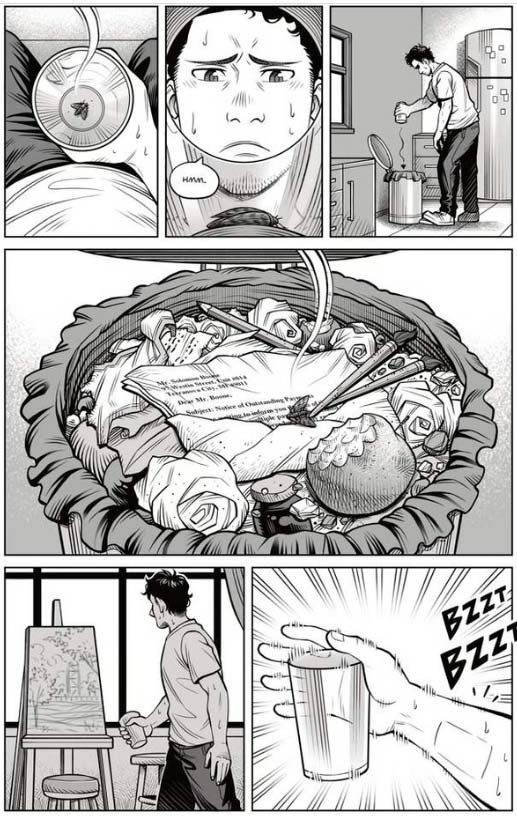
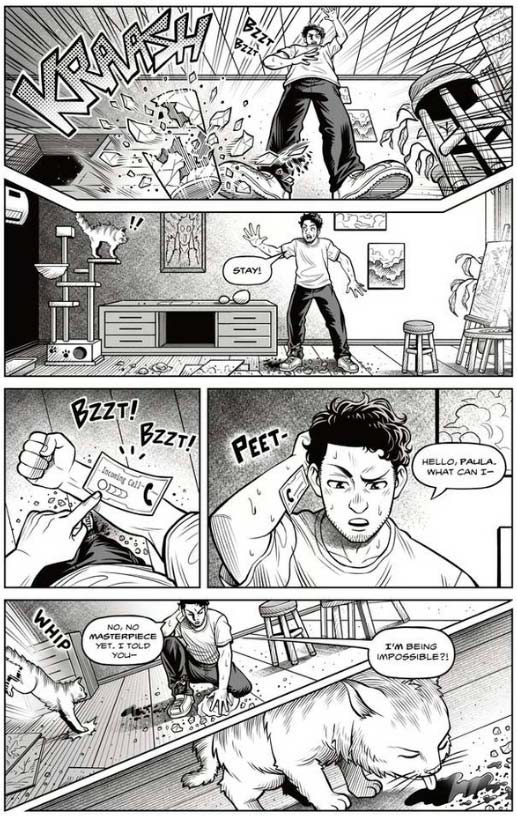
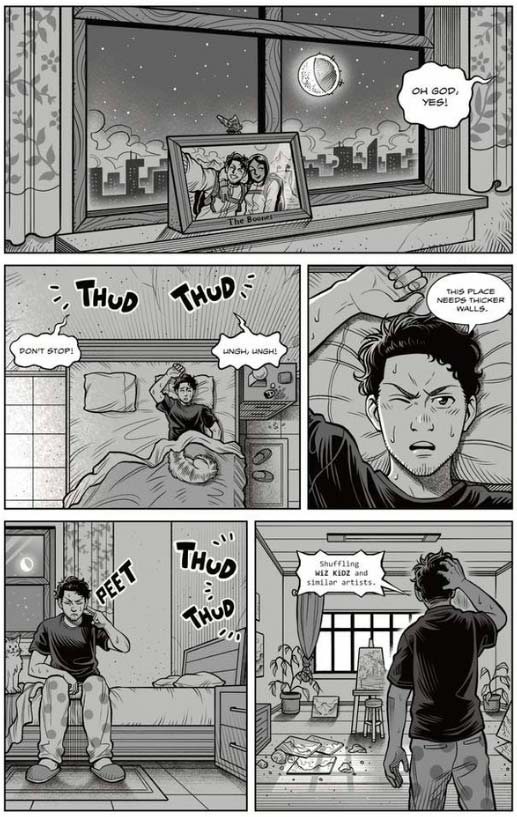
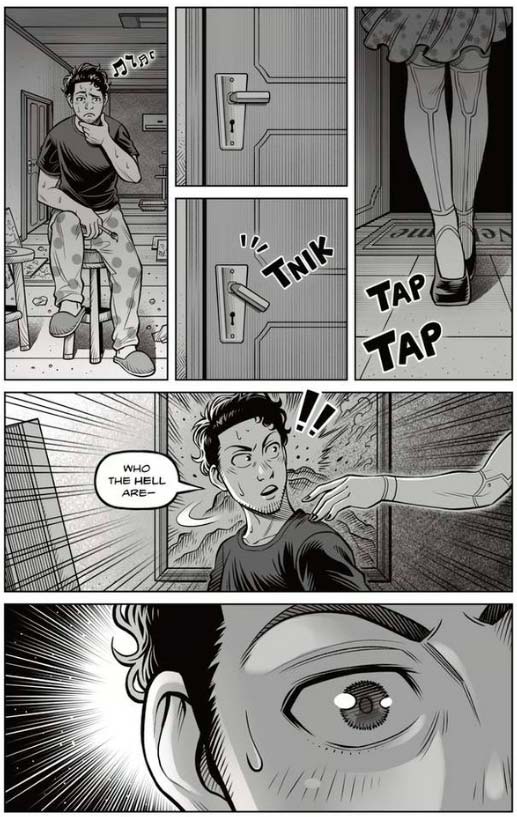
This isn’t a trick post… What are your impressions and expectations?
If you’re like me, after reading these pages you’d probably guess this is some sort of slice-of-life drama… If you noticed the girl in the last few panels is actually a robot, you might even say, it’s sci-fi…
You also might have noticed the single struggling artist and sexual inneundo… which makes Romance a solid guess too…
Turns out, this material comes from;
Muse, a single-shot horror comic.
(thanks for creator Ryan Messcher for letting me use the art in this article. Muse looks cool and it’s always nice to see people producing one-shots, a rarer breed these days–you should check it out.)
This approach to pitching, marketing and otherwise showcasing a comic is a common one.
The mistake is typically made because the creator is so close to the work, they see the setup material as a wonderful segue into the rest of the cool book and don’t want to lead with any of the books big surprises.
The assumption: showcasing the book’s stronger turns or reveals will somehow dilute the impact of the story when it’s read by the customer… but to borrow a quote from Jack Reacher… “In an investigation, assumptions kill.“
I’ve written a bunch about establishing mystery. Mystery through secrets gives some effective ways to tackle it…
But the big misconception that can ruin the effectiveness of a promotional showcase like the Muse pages above, is thinking withholding information creates mystery.
It doesn’t.
Withholding information creates indifference. If I don’t know what kind of story I’m looking at, I’m not intrigued. I’m just confused. And confused people don’t back comics or purchase books.
When it comes to marketing, whether your showcasing sample pages or writing a back cover blurb, the rule is simple:
Highlight the best parts of the story.
You don’t create intrigue by hiding what your story is. You hook new readers by showing them exactly what the story is. And if seeing your story for what it truly is spoils the surprise of actually reading it, your story doesn’t have legs…
- If you’re pushing horror, your preview pages better put dread front and center. (Or in the case of Muse, specifically a body-horror tale, you better have blood and guts exploding off the page.)
- If you’re pushing a thriller, your blurb better have more tension than the Verrazzano.
- If you’re pushing a comedy, your sample better make the reader laugh.
Think about every movie trailer you’ve ever watched. Do they show you disconnected setup material early in act 1? Or do they highlight exactly what the story is?
For the perfect example, we need look no further than the new Resident Evil trailers running everywhere…
You do NOT see 2 minutes of the dude going about his daily transport job. Talking to his girlfriend. Hanging out with his family. Playing with his cat. Then at the end, see him look up and hear a zombie growl.
You get 2 minutes of him running, scrapping for guns, zombies throwing themselves off of rooftops exploding in blood, baby zombie arms reaching up, screaming, more running, zombies chasing through a field, etc…
It’s 2 minutes of zombie horror survival action.
A good movie trailer shows you enough so you walk into that theater knowing exactly what you signed up for.
The surprise isn’t learning what genre the movie is. Or even what the movie is about… The surprise lands with exactly how the awesome bits of the trailer come together for the full 90 minutes.
Now, does that mean you put your biggest turns and reveals in your promo? No.
In fact earlier I said if you put your early turns/reveals in your promo and it kills your story, your story is underdeveloped… but the opposite also holds true to… if all you have to highlight is your climax third act turn/reveals, or just one or two to choose from across the whole story, your narrative is just as underdeveloped.
So where do you actually pull your promo material from?
The trick is focusing on the active story’s fundamentals. A story’s fundamental elements are what gets someone to commit.
Interestingly, we can look at a well developed logline for the answer.
A writer’s logline showcases a number of specific elements. (I’ve linked the Story To Script article which gives you the core elements before the member paywall if you want to go jot them down.) And here’s the bottom line;
Your first act introduces the elements the logline requires, but it’s the active story of the second act that establishes them.
Let’s take a look at the Matrix to see what I’m talking about, the difference between the Act 1 Introductory version and the Act 2 (and beyond) Active story version:
Protagonist
Act 1: Neo is a bored cubicle worker who moonlights as a hacker, searching for something missing from his life.
Act 2: Neo is a recruited soldier in an underground war, training to weaponize a reality he just learned is fake.
Genre
Act 1: Plays like a paranoid conspiracy thriller.
Act 2: Full sci-fi action.
Stakes
Act 1: Neo might get arrested or killed by the agents chasing him.
Act 2: The survival of free humanity.
MAF
Act 1: Agent Smith is a threatening government spook who interrogates Neo in a holding room.
Act 2: Agent Smith is a sentient program designed to hunt and eliminate threats to the Matrix.
Concept
Act 1: The world is a monotonous hollow shell of existence.
Act 2: Humanity is enslaved in a constructed simulation where certain people can learn to break its rules.
Working on a lot of Noir toned material, I know first-hand how difficult it can be when there’s a big divide between the first two acts, and when your turns and reveals are actually critical to the narrative (a hallmark in more mystery/suspense fiction)…
My own cyberpunk noir novel, Crashing Eden, is a good example.
The blurb tells you that Carr Callister, an outer-sector hacker, accesses the wrong network and starts losing time, maybe losing his mind. Sector police and corporate detectives closing in. You know exactly what kind of story this is, fast-paced, dark, cyberpunk thriller.
That’s the pitch and promise.
What the blurb doesn’t tell you is what actually compromised him, what he’s really up against, or how he’s actually going to survive it. Those are the surprise experiences (the turns/reveals) you get by reading the book.
And take note on Crashing Eden’s webpage…
The free sample pages don’t showcase the Protagonist in his shitty apartment, printing up a pizza for dinner. That actually happens in Act 1, but that’s not really cyberpunk, no instead, the sample pages drop you right into the Protagonist as he stumbles into a dark network chased by cyber security cops.
Browsers can feel the noir cyberpunk genre before they commit a single dollar.
Looking back to the Muse sample pages… Those pages don’t have anything in them that screams horror. Heck, they don’t even have anything in them that whispers horror. It showcases pleasant, neutral, genreless setup.
SURE, you can say people will read the rest of the Kick page and understand that the book is horror in nature… but those sample pages create a disconnect. The crowdfund sells horror, the actual book pages sell “trust me, I promise it’s horror.”
Instead, they should have shown enough horror to make someone say, “Wow, I need to see where this goes.” One unsettling image or moment of genuine creep. That’s all it takes.
Strangers don’t know you or trust you.
You have to earn that trust right off the bat by showing them your best.
So before you launch your campaign, submit your query letter, write your blurb, or pick your sample pages ask yourself:
If someone looks at the material with zero context, are they seeing some of the best elements of the story? Does it tell them what kind of story they’re about to experience in spades?
If the answer is no, you haven’t protected your surprises. You’ve hidden the life of your story. And hidden products never sell. ▪
About the Author —
If you found this article helpful, please share the direct link on your social media.
Nick Macari is a developmental editor and story consultant with near 30 years across comics, games, novels, and screenplays. He’s the author of Storycraft For Comics, the Working Writer’s Guide to Comics and the creator of the SCAR system referenced in this article.
If you’re developing a series and want a professional assessment of your project’s scope, structure, or viability, get in touch through the inquiry form or the direct contact info on the site sidebar.