One of the top three problems I see from new writers is passive writing. Because fixing it dramatically improves a work, it’s also one of the first things I tend to address when working with said writers.
For some reason I see a lot of passive writing in comics.
Not sure why it gets a pass by many comic editors… but if you want to sharpen your script to a carbon razor edge, drop it.
So what exactly is Passive Writing?
Passive writing is an umbrella term that encompasses a few poor narrative choices. Ultimately, they all lead to one thing, telling the reader what’s up, instead of allowing the reader to experience it vicariously through the characters. Telling distances the reader from the story, whereas immersive writing, pulls them in.
Grammatically Passive Voice
This is perhaps the worst offender of passive writing, but luckily it’s also the rarest because it’s so darn awkward.
Grammatically speaking, Passive voice is when the subject of the sentence receives the action instead of performing it.
“A large black form could be seen beneath them.”
“The magical herbs had been collected by the amazon.”
“Sounds of the city were eaten by the night.”
Distant Reporting
Although technically not grammatically passive, sentences can still FEEL PASSIVE as the writer distances the reader from the subject performing the action. Oversaturation or reliance on state-of-being verbs, primarily “be” (as in “to be”) is known as distant reporting. Dropping a little distant reporting here or there, isn’t really an issue, but when it takes hold of a narrative, you’re in trouble.
Distant reporting creates a clinical, static, often flat, report like tone to the writing. Heavily relying on “be” verbs often reduces moments to static declarations and nothing more.
“There was a large black form visible beneath them.”
“The magical herbs were now in the possession of the amazon.”
“The sounds of the city were no longer present.”
Distant reporting is one of the most common forms of passive writing I encounter. Folks who don’t realize they’re doing it, tend to completely load up their scripts with it. It’s amazing how much cleaner a script reads when you break out of this passive habit.
Sensory Filtering
Remember passive writing is writing that keeps the reader at a distance. In this instance, sensory filtering blocks the reader with verbs or phrases that describe a character’s mentally perception, observation, or experience.
“They saw a large black form beneath them.”
“He watched the amazon collect the magical herbs.”
“They heard the night eat the sounds of the city.”
Again, these are all active voice, but they feel passive. Words like “saw, watched, heard,” act as short-cut words, bar bouncers, blockers. Words that state how the character sensed something, but don’t actually draw the reader to how those senses unfolded.
It’s literally Vin Diesel standing with his hand up, “Yeah, they saw that black shape. That’s all you need to know about it. Keep moving, buster.”
Straight up Telling not Showing
Similar to the last point, sensory filtering, but now the gloves come off. The writer doesn’t limit themselves to cognitive words, but grabs at any kind of exposition or fact spitting phrases.
“A large black form occupied the physical space beneath them.”
“The amazon collected her magical herbs.”
“All ambient noise in city ceased.”
Proper Writing
Active voice, pulling the reader into the moment. Forgive the crude nature, I’m throwing these out off the top of my head.
“A large black form surfaced from the deep, nearly capsizing the ship in its horrible wake .”
“Fluorescent yellow pollen spiraled in a great big puff as the Amazon cinched her herbal pouch.”
“A crisp stillness hung on the starless night.”
Of course there are times and places where passive sentences come in handy. When the subject is unknown (or unimportant) for example, or ambiguity is intended (among a few others), but generally speaking passive sentences should appear few and far between.
Before we leave, let’s take a minute to talk about passive writing behind the scenes in script writing. The stuff that shows up in the actual panel descriptions, not the reader facing side of things.
It’s particularly easy to rely on “to be” verbs when you’re writing a tight script. There tends to be a natural inclination to use them when your relaying a specific set of instructions. While weak verbs can translate the meaning you’re looking to express, scripts relying on weak verbs almost always come across wordy, inefficient and like a set of home appliance instructions, just plain boring.
Let’s take a look at what I’m talking about.
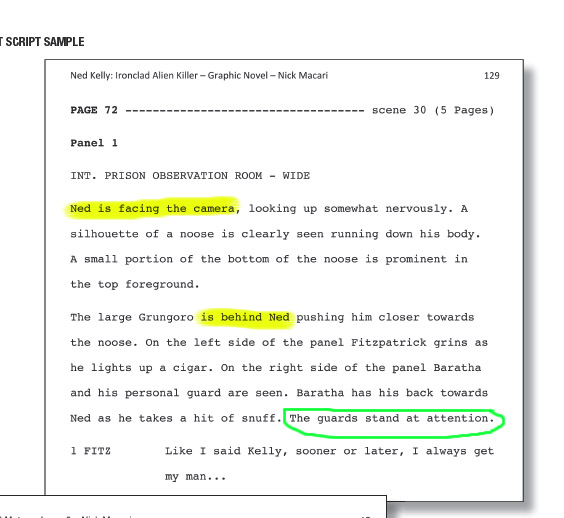
Notice above, I highlighted two spots where I relied on “is”.
Often a “to be” verb will be followed by a present participle verb–a word ending in “ing” (not always, but often the case). If you find a lot of “ing-ending verbs” in your script, stop and review, you can probably tighten things up a bit.
I also circled a spot where a direct verb was used. Notice how much shorter and precise the sentence is.
Now here’s another version of the same panel with the “to be” verbs edited out. You’ll probably agree, the new version is cleaner, more efficient and just reads better.
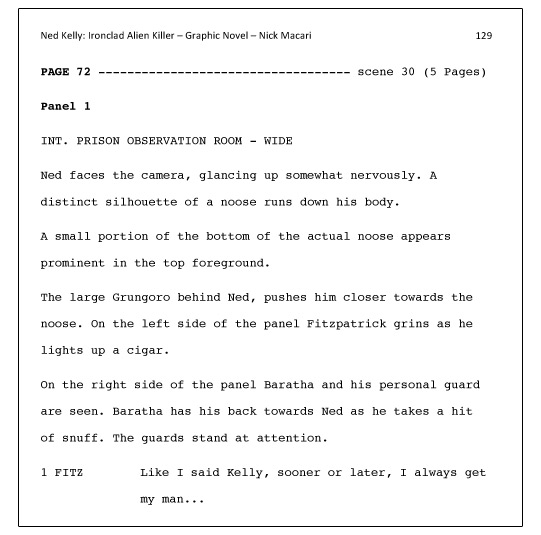
Hardly a perfectly written, stellar panel, but I think you get the point.
You may notice in the revised version I switched up a couple of words. I talk more about diction and verb selection in the writing visually section of the “Working Writer’s Guide to Comics and Graphic Novels”, so I’m not going to delve into that here.
Writing in the active voice creates more efficient, easier to understand and usually sharper sentences. Avoiding the “to be” verbs makes for a more focused, efficient script.
Particularly important aspects when writing in the limited confines of a comic book narrative.▪
About the Author —
Nick Macari is a full-time freelance story consultant, developmental editor and writer, working primarily in the independent gaming and comic markets. His first published comic appeared on shelves via Diamond in the late 90’s. Today you can find his comic work on comixology, amazon and in select stores around the U.S. Visit NickMacari.com for social media contacts and news on his latest releases.
For more tips, bookmark the writing craft page. For all the tips buy the book.
Show your support by sharing the writing craft page on your social media.
© 2016 Nick Macari. No reproduction without written permission.
One thought on “Pass the Passive Writing – Updated”
Comments are closed.