The visual nature of comics tend to keep this problem in check, it is far more common in long prose, however I still come across it in scripts now and again. It’s definitely something you want to be aware of, for when it appears, it tends to derail a script in a big way.
The pillars of causality support all fiction; cause and effect, action and reaction, choice and consequences.
Narrative triggers, or Narrative Catalysts as I prefer to call them are specific moments in dialogue, action, or plot, that allow the narrative to pivot or turn in a new direction.
Without narrative catalysts, you wind up with non sequiturs. Statements, actions, or conclusions that don’t logically follow from the previous position.
Instead of illustrating the concept from scratch, I decided to grab a couple pages of The New Mutants, #38, Chris Claremont on words. Let’s get it.
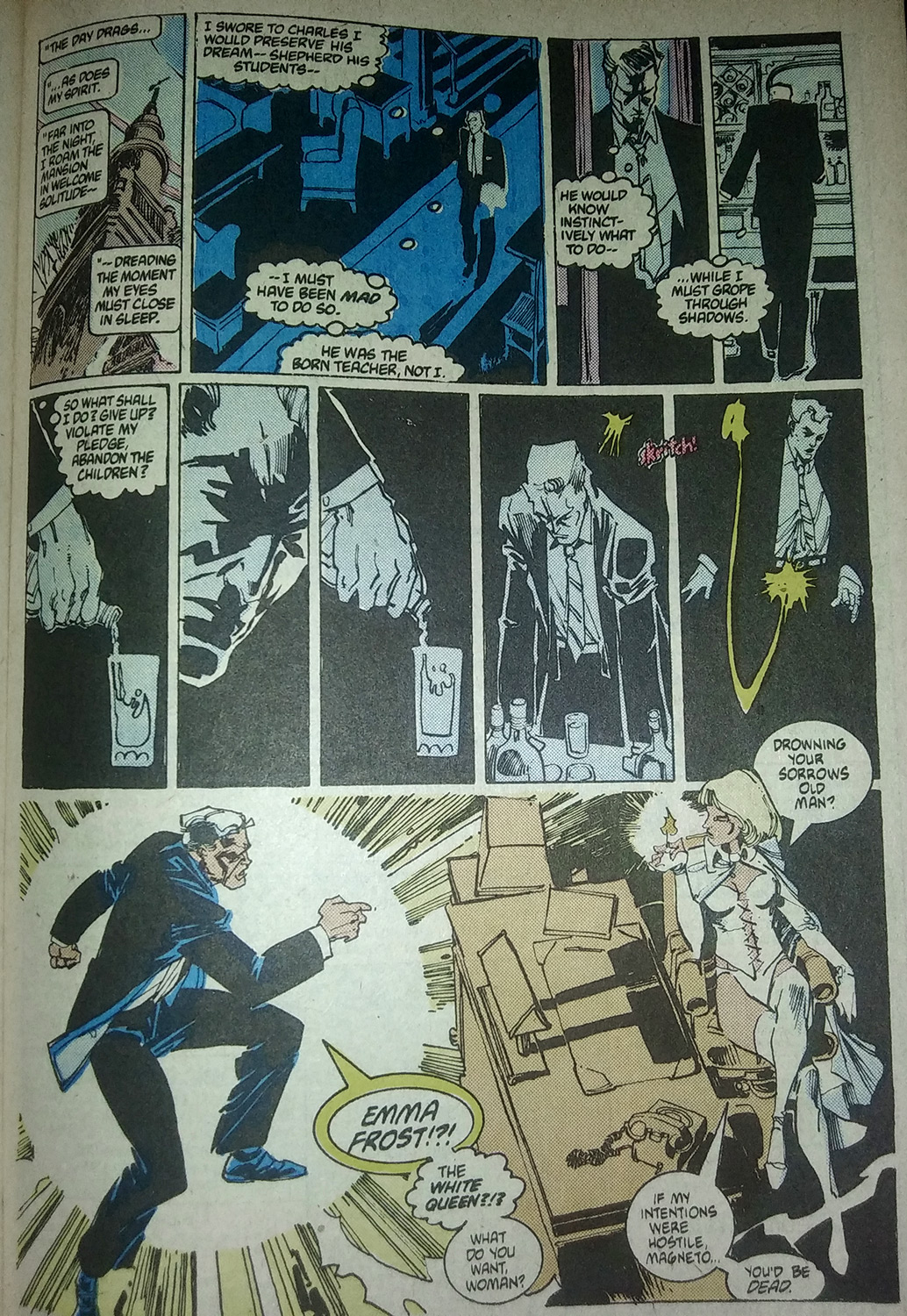
On the next page, the White Queen and Magneto have a short discussion where she makes him a business offer. Because there are no narrative catalysts, the dialogue is pretty straight forward without any escalation, both in an emotional or physical context.
Now, let’s pretend for a moment and throw out all context.
For the sake of this example, Emma becomes a random woman. And we’re going to diverge from the mundane interaction that I just explained with the following;
Magneto, surprised by the uninvited guest demands to know what the woman wants.
Instead of the dialogue on the right side of the last panel, she replies by savagely and passionately sexually assaulting Magneto.
Such a display/reaction on the mysterious woman’s part, happens without any narrative catalyst. Without justification. Her actions feel confusing, disjointed… random.
Let’s rerun it and do it from another angle.
Magneto, surprised by the uninvited guest demands to know what the woman wants.
She replies just as it’s presented. In fact, we’ll add one more line, “I’m here to discuss your students. From what I hear they’re in some serious trouble.”
Now on the next page, Magneto uses his powers to split the metal frame of the desk in half, hurling it to the sides of the room, as he proceeds to drop kick the mysterious woman in the chest. While she’s gasping for air, Magneto takes up the landline phone from the floor and feverishly smashes her in the face.
This time Magneto’s actions happen without any narrative catalyst. The mysterious woman says she’s just there to talk about his students and he goes beserk trying to kill her. If this wasn’t explained away in the following panels, readers would be left scratching their heads saying, “Damn, what the hell??”
Narrative Catalysts anchor responses in narrative logic. They give them justification and immediate context.
Narrative catalysts can arrive small and subtly, pivoting the narrative with a tiny nudge, or in huge obvious ways, throwing it off a cliff.
Let’s look back at our first example, where the woman gets up and throws herself at Magneto, tearing his clothes off and demanding his body. What narrative catalyst can you think of to anchor those actions from her?
Don’t read further, take a minute and come up with something.
…
A single small, subtle line of dialogue from Magneto came to my mind…
“Jennifer, it’s been a minute.”
This approach doesn’t explain Jennifer’s sexual appetite, but it does create an instant history between the two characters. While the reader doesn’t understand the context of her response, they understand there is something between them in their history that warrants it. In fact, this particular instance, develops a strong sense of mystery. The reader wonders exactly what took place in their past to make this reaction.
The reader won’t say it in their mind, but they are exactly, specifically, wondering what narrative catalyst took place in their backstory!
How about the second version?
What narrative catalyst can you think up, that would anchor Magneto into profuse violence?
Go ahead and take another minute.
Ok, I’m going to cheat a little. I’m going to inject a flashback scene, in which, the mysterious woman shoots Magneto’s son in the head.
Revealing this atrocity to the reader, gives instant justification and context to Magneto’s brutal attack.
BONUS:
If you look back at the sample New Mutant’s page… there’s actually a specific narrative catalyst right in front of our eyes? Do you recognize it? I’ll point it out at the end of the article.
Let’s do another. (I’m gonna have some fun with this one.):
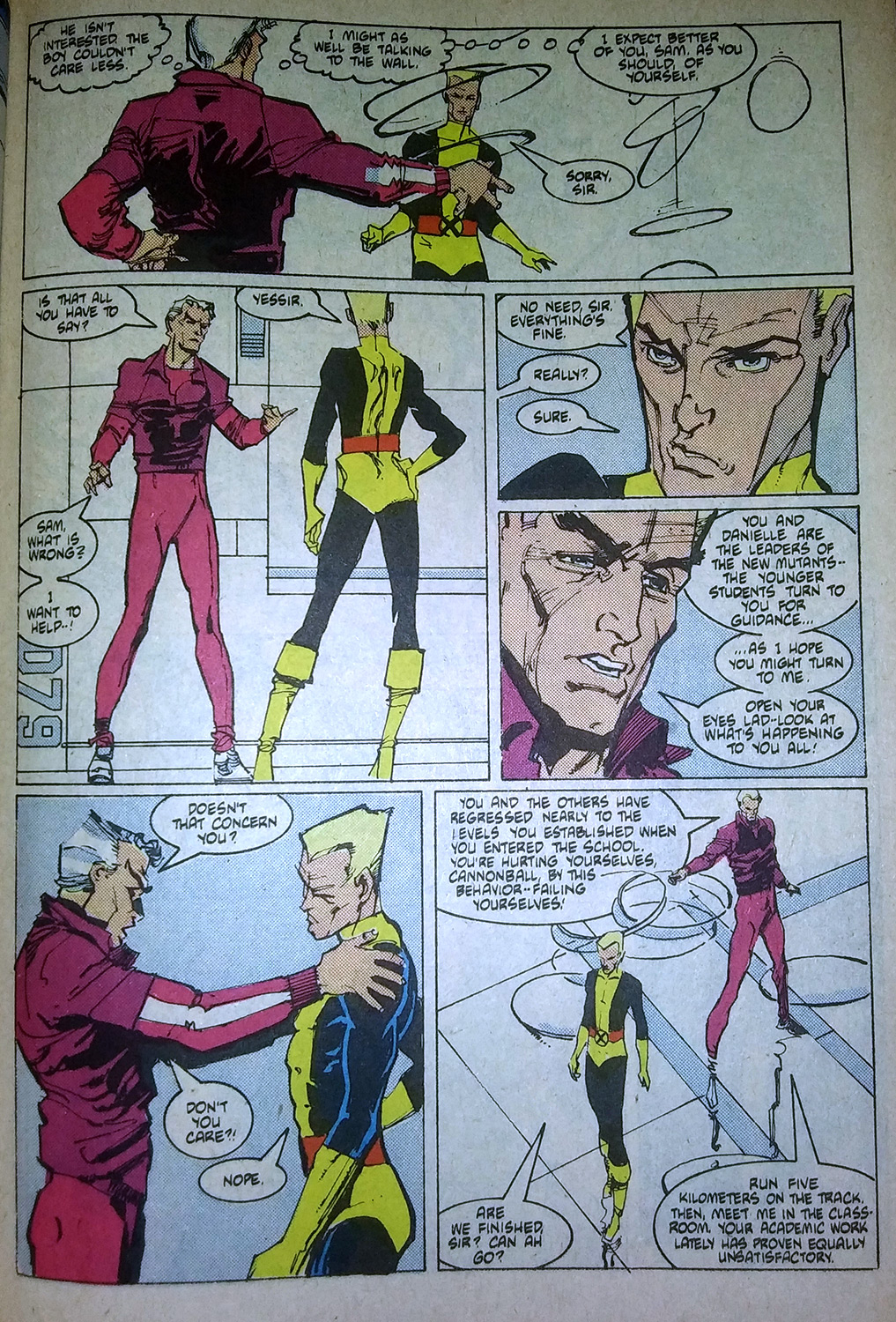
Now that I’ve presented another page from the New Mutants issue #38, I’m’a mess it up real good for you to illustrate what happens when Narrative Catalysts go missing.
Go ahead and read my version and see if the narrative suddenly feels disjointed or confusing when you get to my dialogue parts. If you already the normal version, feel free to read just panels 4,5 and 6 this time.
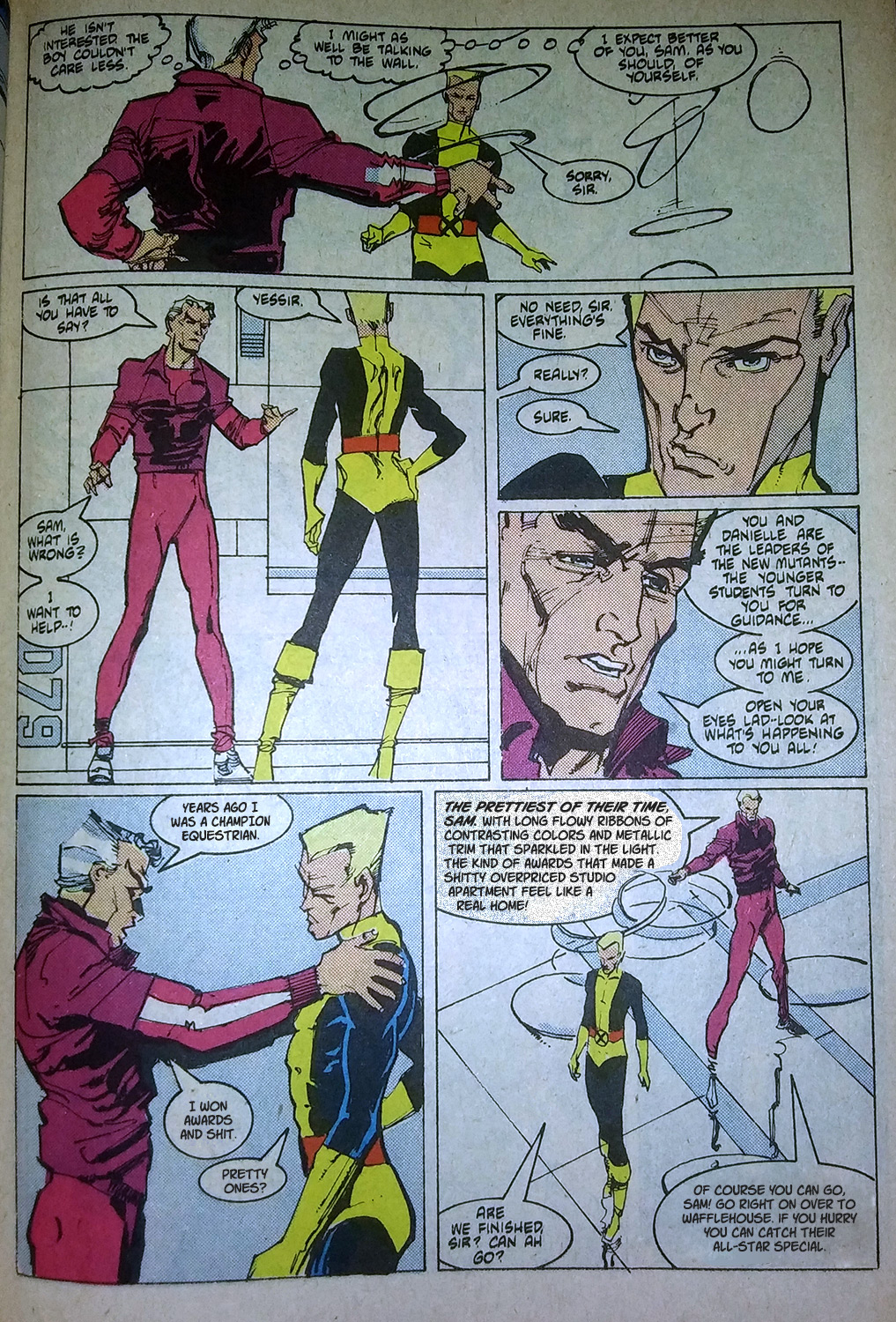
Hopefully you see the abrupt change to a new subject, Magneto’s equestrian past, is an unjustified narrative pivot. It feels completely out of place and if reading this in a real issue, would most certainly come across completely confusing reading like a blatant mistake in the script overlooked by the series editor.
Note, the narrative catalyst I added in the last frame. Well, actually, I didn’t add it, I simply used it. I played off of Cannonball’s query of whether or not he could go, as a segue into Magneto’s Wafflehouse advertisement.
Of course, it sounds clunky and out of place, because there’s a total contrast in context with the rest of the page… BUT, with the narrative catalyst, it actually does makes sense.
This examples show how missing narrative catalysts push your narrative into non sequitur territory. Something to be avoided at all costs, unless, maybe you’re working on a comedy genre script.
Invisible Narrative Catalysts
There are times when narrative catalysts don’t appear right in front of the reader, segueing directly from one element on the page to another. Let’s touch on two tricky types of invisible narrative catalysts:
Context
In our first sample page, without any narrative catalyst, PERHAPS, the White Queen actually already has a sexual connection to Magneto. Perhaps the readers already know the two had a romantic relationship long ago… for an even stronger association, maybe it was one Magneto wanted to keep going, but Emma broke off. If this were the case, a sudden, unprovoked sexual assault, would be totally “in context” for their relationship/backstory.
In other words, the narrative catalyst for the action actually does exist, it’s just not visible at the moment. It’s invisible, having happened in the past.
Context of the people, plot, situation, etc. can by itself, be a narrative catalyst.
In a similar vein, the same applies to characters themselves.
Characters
Unless we’re meeting a character for the very first time, every character performs with expectations–both deriving from their history and their core personality. This is why we can refer to a character doing something “in” or “out” of character.
A character’s very nature can act as an invisible narrative catalyst to action/reactions.
Magneto does not carry himself like a savage, unhinged character. The violence he performs in our second example is quite our of character. We don’t expect him to react that way in that situation. However, Magneto does have violence and trauma in his backstory. While a character doing something totally out of character can create a logical break, that a script simply can not recover from, in this instance, we can accept, that maybe, given the right circumstances, Magneto could actually be pushed to that level of violence.
But as I said earlier, when a character does anything out of character, as a writer, you have to move fast to justify it. Else you risk disconnecting your readers completely.
And of course, it’s not just about personality. A character’s backstory and actual experience can circle back and give context as we pointed out above. Whereas context can come from sources outside of a specific character, characters themselves always have some measure of history or context to frame their actions.
Segues
Segues are similar to narrative catalysts. A segue is basically a seamless transition from one story element to another. They’re similar in the sense that there has to some sort of underlying logic (or association) for that transition. If there’s no logic, then it’s just an abrupt cut, there’s nothing “seamless” about it.
Segues are different than narrative catalysts in that they can be quite a bit more abstract in nature; with no real structural underpinnings.
For the most basic example, we can look at a visual match cut. Say Cannonball decides to race away from Magneto in his Jeep Cherokee… then in the next scene, Sunspot pulls into a gas station in his Nissan Skyline. That’s a segue cuing off the vehicles.
Or someone Magneto could announce all the students are breaking for lunch, then the next scene transitions to the Hulk shaking the contents of a mobile taco truck into his wide open mouth.
The segue creates a relationship, BUT it’s not necessarily grounded in any pillars of causality. Narratively speaking, the hulk eating tacos has nothing to do with the New Mutants going out for lunch.
One of the early articles I put on this site, was a fairly in-depth look at various kinds of transitions. Holy cow, can’t believe I posted Cuts and Transitions 10 years ago! Man, time flies when you’re writin’ comics.
Anywhos, often when editing scripts, I’ll note that a segue is too weak, too abrupt, or has some other particular issue… but the reality is, narrative catalysts are far more important. Improper segues can feel awkward, improper narrative catalysts break scripts.
Bonus Answer:
Before we go, it’s time to reveal the narrative catalyst Claremont uses on our first sample page from New Mutants. It’s Magneto pouring his alcohol. Chris takes 4 panels to showcase the alcohol. And it’s from this small narrative catalyst that the White Queen delivers her first line, “Drowning your sorrows, old man?”
Think about it, she could have delivered any one of a million lines, “It’s good to see you again, Max.” or “Pardon my intrusion, but I have urgent business to discuss.
Instead, Claremont used the alcohol to usher in the White Queen. ▪
About the Author —
If you enjoy this article, please share the direct link on your social media.
Newcomer or veteran writer, if you’re working on a project that needs commercial success, Nick urges to you read this intro article.
Nick Macari is a full-time freelance story consultant, developmental editor and writer, working primarily in the independent gaming and comic markets. His first published comic appeared on shelves via Diamond in the late 90’s. Today you can find his comic work on comixology, Amazon, and in select stores around the U.S.